|
Danger
|
• |
Do not touch or modify any high-voltage components. Doing so could result in death or serious injury. |
|
|
Warning
|
• |
Do not use charging cables or charging ports that in any way are damaged or inoperable. Doing so could result in serious injuries or fire. |
|
• |
Ensure the charging cable and associated parts are not soaked in water. Using damp and wet charging parts can result in serious injuries. |
|
• |
Do not touch the charging cable in case of thunder or lightning strikes. Doing so could result in serious injuries. |
|
• |
The car must only be charged with approved, grounded charging stations. If the capacity of the charging station is unknown, do not use it. Doing so could result in serious injuries or fire. |
|
• |
Do not let children be unattended anywhere near the car while charging. Contact with high voltage can cause death or serious injury. |
|
• |
Do not charge the car in an environment where flammable and explosive items are stored or used. Doing so could result in serious injuries or fire. |
|
• |
Do not charge the car with a current exceeding the maximum permitted charging current. Doing so could result in serious injuries or fire, and damage to the components. Always follow local and national recommendations for charging from home charging stations. |
|
• |
Do not wash the car while the charging cable is connected, or the charging hatch is open. Doing so could result in serious injuries. |
|
• |
Do not let anyone besides emergency services handle any type of fire in the car. Doing so is very dangerous and could result in death or serious injury. If the car is on fire, quickly evacuate the area and call the emergency services. |
|
|
NOTICE
|
• |
Do not try to unplug the charging cable from the car while charging. Doing so could result in damage to the charging components and the high-voltage system. Always interrupt the charging before unplugging it. |
|
• |
Do not interfere with the charging hatch when it is opening or closing. Doing so could damage the charging hatch. |
|
• |
Do not bundle charging cables while charging. Doing so can lead to damage to the charging components and the high-voltage system. |
|
• |
Avoid fully discharging the high-voltage battery. If it occurs, charge the car as soon as possible. Leaving the car discharged might cause serious damage to the high-voltage battery. |
|
• |
Insert and pull out the charging cable without using big force, tilting, or wiggling, to avoid any damage to the charging equipment or the car. |
|
• |
Do not expose the charging cable to direct sunlight. The overheating protection can reduce or interrupt the charging. |
|
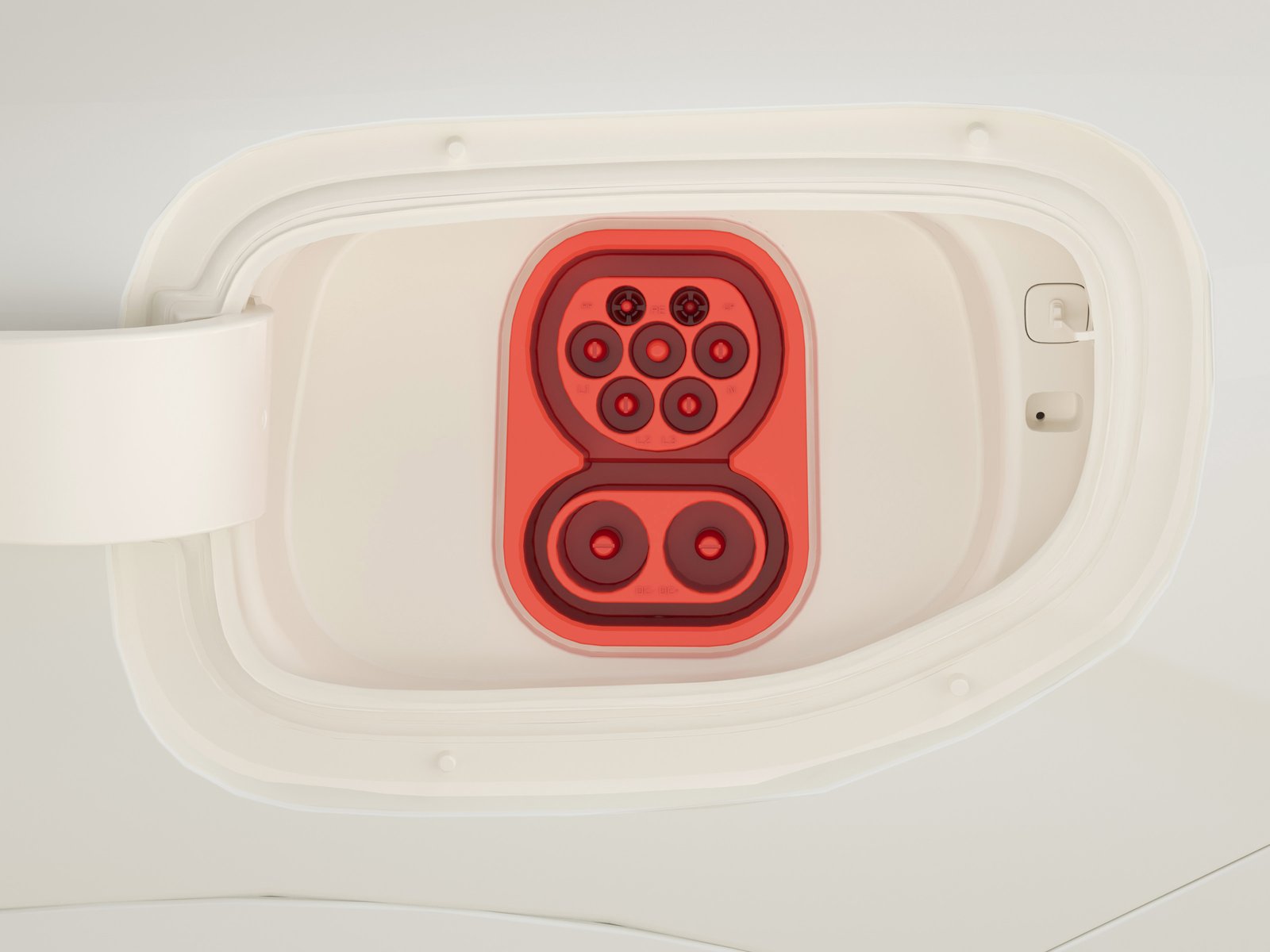
The car's electric motor is powered by a high-voltage battery, which is charged through the charging port. Charge the car through a public charging station or a charging station at home.
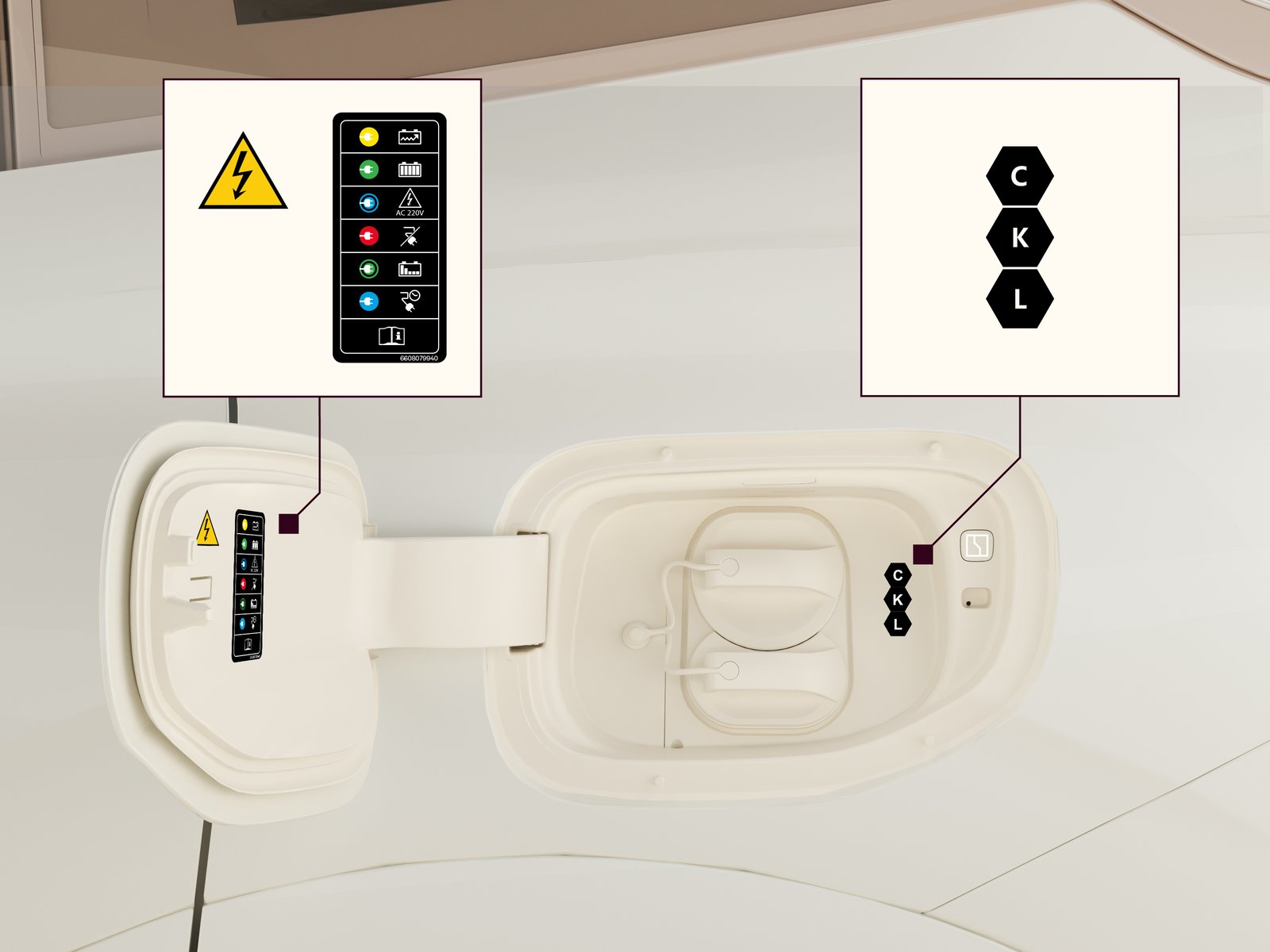
Inside the charging hatch are the charging status label, high-voltage warning label, and charging compatibility identifier label (hexagons with bold letters).
Other high-voltage components in the car are also identified by the high-voltage warning label, and high-voltage cables are orange. Do not modify or interfere with any high-voltage components or high-voltage cables.
To charge the car, use a compatible charging station. The identifier on the car must always match the identifier on the charging station, according to EN 17186.
| Label |
Description |
|
|
AC charging |
|
|
DC charging, voltage up to 500 V |
|
|
DC charging, voltage up to 900 V |
The car has one charging cable as standard equipment. This charging cable is found in the storage area below the hood.
The battery's level of charge and the expected range are shown in the center display and the Zeekr app.
We recommend:
Press the battery symbol in the top toolbar to go directly to the Energy management menu.
AC and DC charging
The car can be charged either with alternating current (AC), or direct current (DC). DC charging shortens the charging time significantly compared to AC charging and is normally referred to as fast charging.
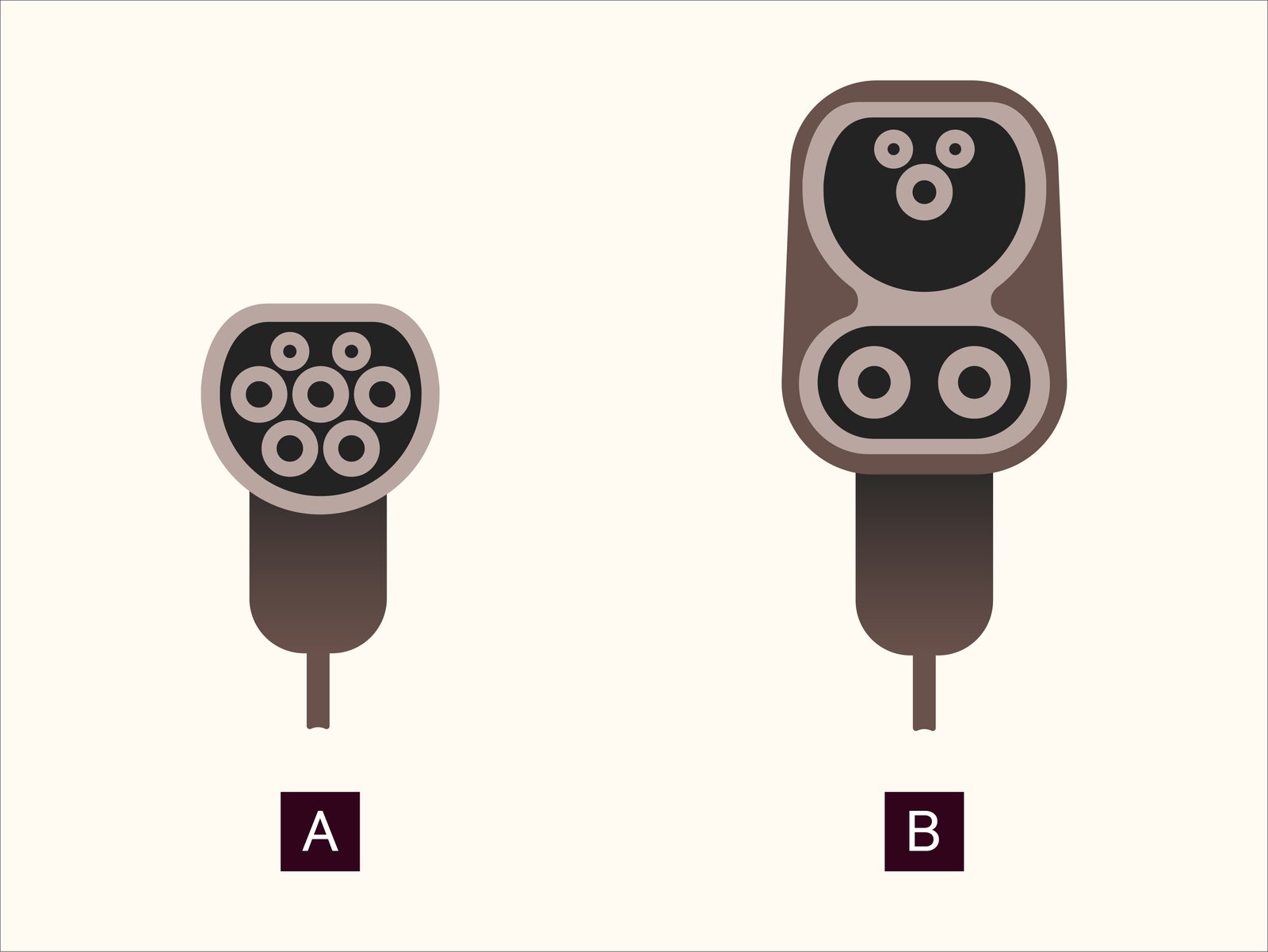
Different charging cables are used for the two types of charging. An AC charging cable has interface

and a DC charging cable has interface

.
The car's charging port fits either charging cable.
Use the Zeekr charging cable to charge from an AC charging station that does not have an integrated charging cable.
For DC charging make sure to:
|
• |
Only use stations marked with CCS 2 (Combined Charging System 2). |
|
• |
Follow the instructions of the DC charging stations to start and stop the charging. |
|
• |
Use the charging cable which is integrated with the DC charging stations. The charging cable between the car and the charging station must always be shorter than 30 meters. |
Charging status
The LED by the car's charging port indicates the charging status of the battery. The label on the inside of the charging hatch illustrates the status.
| LED status |
Charging status |
| Solid yellow |
Preconditioning the battery |
| Solid green |
Charging complete |
| Flashing blue |
Discharging in progress |
| Solid red |
Charging fault |
| Flashing green |
Charging in progress |
| Solid blue |
Charging scheduled |
| Solid white |
No charging ongoing. Courtesy light. |